CCTV Camera Cable Guide: Types, Length Limits and How to Choose
The right CCTV camera cable decides whether your surveillance system delivers a sharp, steady picture or a flickering, noisy one. Many installers blame the camera or the recorder when the real culprit is a poor or wrong cable. Whether you are fitting a shop, a factory, a housing society or a home, choosing the correct cable type, length and quality up front saves repeat site visits.
This guide explains the main types of CCTV camera cable, how far each can run, and what to check before you buy in bulk or pre-made lengths.
What Does a CCTV Camera Cable Do?
A CCTV camera cable connects the camera to the recording system, whether that is a DVR, NVR or PC-based recorder. Depending on the system, it carries the video signal, the power supply, or both. Weak shielding, thin conductors or poor insulation show up as ghosting, rolling lines, signal loss and cameras that reset at night.
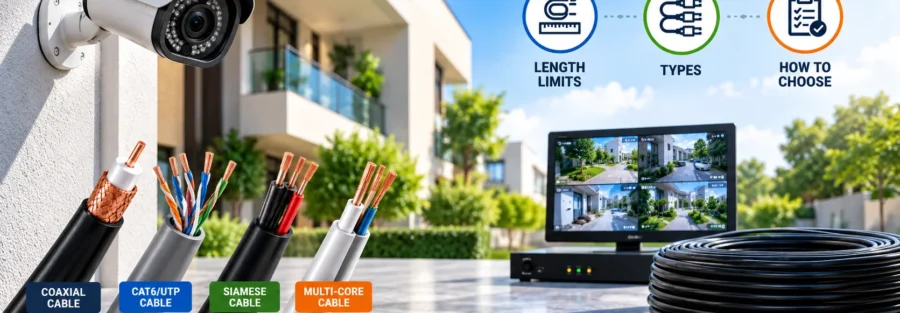
Main Types of CCTV Camera Cable
Coaxial Cable (Analog and HD Analog Systems)
Coaxial cable, commonly RG59, carries the video signal from analog and HD analog cameras to a DVR. It has a central conductor, insulation and a shield that protects the signal from interference. Power is supplied through a separate pair of wires.
Siamese Cable (Video and Power Together)
Siamese cable combines a coaxial video cable with a power cable in one jacket. It is popular with installers because one cable run feeds both video and power, reducing clutter and installation time.
Ethernet Cable (IP Camera Systems)
IP cameras use network cable such as Cat5e or Cat6, and many are powered over the same cable using Power over Ethernet (PoE). The Ethernet standard limits a single run to about 100 metres without extra equipment.
CCTV Camera Cable Types Compared
Cable Type
Used For
Carries
Typical Run Limit
Coaxial (RG59)
Analog / HD analog cameras
Video only
Roughly 200 to 300 m, depends on camera and signal type
Siamese (coax + power)
Analog / HD analog cameras
Video and power
Similar to coax; power drop limits long runs
Cat5e / Cat6 Ethernet
IP cameras, PoE
Data and power
About 100 m per run
Run limits vary with the camera, resolution and cable quality, so treat these figures as planning guides and confirm them against the camera maker’s datasheet.
Power Cable and Voltage Drop
Most analog cameras run on low-voltage DC power, often 12V. On long runs, thin power conductors lose voltage, and the camera may dim, flicker or restart, especially when infrared night vision switches on. For longer distances, use a thicker power conductor, a higher-capacity power supply, or power the camera locally near its position. This is one reason a good CCTV camera cable matters as much as the camera.
Bulk Rolls or Pre-Made Cables?
Installers can buy CCTV camera cable as bulk rolls or as pre-made power and video cables. The right option depends on the job.
Bulk rolls suit large sites and custom lengths, and cost less per metre, but need proper connector fitting
Pre-made cables suit small installations and quick fitting, with connectors already attached
Camera type: analog, HD analog or IP, which decides coax or Ethernet
Run length from the camera to the recorder, plus extra for bends and slack
Conductor quality: ask whether conductors are pure copper
Shielding and insulation quality, especially near electrical wiring
Outdoor needs: UV-resistant, weatherproof sheathing for exposed runs
Manufacturer details, so you can trace and claim on a faulty lot
Installation Tips for Cleaner, Longer-Lasting Runs
Even a quality CCTV camera cable underperforms if it is installed badly. A few habits make a visible difference :
Plan the route first and measure it, adding extra length for turns and slack at both ends
Keep video cables at a sensible distance from mains wiring, crossing at right angles where unavoidable
Use conduit or casing for exposed and outdoor sections to protect the sheath
Label each cable at both ends so faults are quick to trace
Test every camera at night as well as in daylight, since infrared load exposes weak power runs
Common CCTV Cabling Mistakes
Running video cable alongside heavy power cables, causing interference
Using one thin cable for every distance instead of matching the cable to the run
Poorly crimped or loose connectors, a common cause of signal dropouts
Leaving outdoor cable unprotected from sun, rain and rodents
Test every camera at night as well as in daylight, since infrared load exposes weak power runs
Choosing a Reliable CCTV Camera Cable Manufacturer
Rajat Cables manufactures CCTV camera cable, including bulk-style power and video cables as well as pre-made lengths, at its Ratlam, Madhya Pradesh facility. The cables are built for durable, high-tensile service and come from a manufacturer operating since 1981 with a 10-year guarantee on its range. Installers, dealers and project buyers can contact our team for specifications, lengths and bulk quotes. You can also see our wider range of wires on the products page.
Frequently Asked Questions
How long can a CCTV camera cable run?
−
Coaxial runs are commonly planned up to roughly 200 to 300 metres depending on the camera and signal type, while Ethernet runs for IP cameras are limited to about 100 metres. Always check the camera datasheet.