Speaker Wire Gauge Guide: How to Choose the Right Speaker Cable
Picking the right speaker wire is simpler than most buyers expect, yet the wrong choice is one of the most common causes of weak, thin or uneven sound. The wire sits between your amplifier and your speakers, so if it is too thin for the distance, power is lost as heat before it ever reaches the speaker. This guide explains gauge, length and impedance in plain language, with a quick chart you can use today.
What Does Speaker Wire Actually Do?
Speaker wire carries the amplified audio signal from your receiver, amplifier or mixer to each speaker. It is a simple two-conductor cable, one conductor for each polarity, and it works best when its electrical resistance is low. Two things control that resistance: the thickness of the conductor, called gauge, and the length of the run.
Why Gauge Matters for Speaker Wire
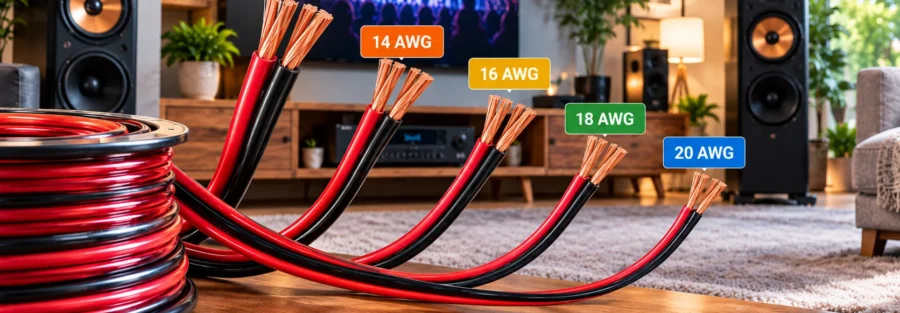
A thinner conductor has higher resistance. Over a short run that hardly matters, but over a long run a thin speaker wire wastes power and can reduce bass and volume. A thicker conductor, shown by a lower AWG number or a larger square millimetre (sq mm) value, keeps losses small. As a rule, the longer the run and the lower the speaker impedance, the thicker the speaker wire should be.
Speaker Wire Gauge Chart by Length
This chart shows commonly recommended gauges for typical 8 ohm speakers. For 4 ohm speakers, move up one gauge size, for example from 16 AWG to 14 AWG.
Run Length (one speaker)
Recommended Gauge (AWG)
Approx. Size (sq mm)
Up to 6 m (20 ft)
18 AWG
about 0.8 sq mm
Up to 15 m (50 ft)
16 AWG
16 AWG
Up to 30 m (100 ft)
14 AWG
about 2.1 sq mm
Beyond 30 m (100 ft)
12 AWG
about 3.3 sq mm
Treat this as a guideline. When in doubt, choose the thicker option, since extra thickness costs a little more but never hurts performance.
Understanding Impedance in Speaker Wire Choice
Impedance, measured in ohms, tells you how much the speaker resists the signal. Most home speakers are 8 ohm, while some are 6 or 4 ohm. Lower impedance speakers draw more current, so they need thicker speaker wire for the same distance. Check the label on the back of your speaker or its manual before you buy.
Copper vs Copper-Clad: What to Look For
The conductor material matters. Pure copper conducts better than copper-clad aluminium (CCA), which is cheaper but has higher resistance and can corrode at connections. If you buy speaker wire, ask whether the conductors are pure copper and check that the stated gauge is real. For typical home, shop and PA use, correct gauge and pure copper matter far more than premium-priced exotic cables.
Other Things to Check When Buying Speaker Wire
Stranding: fine multi-strand conductors are flexible and easier to route and terminate
Polarity marking: a stripe, rib or colour on one conductor helps you wire speakers in phase
Length: buy enough to reach comfortably with slack, and keep left and right runs equal
Purpose: home theatre, car audio, shop sound and PA systems may need different lengths and ratings
How to Connect Speaker Wire Correctly
Switch off and unplug the amplifier before touching any connection
Strip about 10 to 12 mm of insulation from each conductor and twist the strands tightly
Match polarity: positive (red) terminal on the amplifier to positive on the speaker, and negative to negative
Secure the conductors firmly in the terminals or use banana plugs, making sure no stray strands touch the other terminal
Power on at low volume and check that both speakers sound balanced
Common Mistakes to Avoid
Using a cable that is too thin for a long run, then blaming the amplifier for weak bass
Mixing different cable types or lengths between left and right channels, which unbalances the sound
Reversing polarity on one speaker, which makes vocals sound hollow and bass thin
Leaving loose strands that touch the neighbouring terminal and can trip the amplifier's protection
Running cable under carpets or doors where it can be crushed or worn through
Choosing purely on price without checking the real conductor size and material
Speaker Wire for Shops, Offices and PA Installations
Commercial sound systems often run speaker wire over much longer distances than home setups, which makes correct gauge even more important. Installers, electrical contractors and dealers who buy in volume should confirm gauge, conductor material and roll length with the manufacturer, and keep consistent cable across a whole project so that all speakers receive equal power.
Buy Speaker Wire from a Manufacturer
Rajat Cables manufactures speaker cable at its Ratlam, Madhya Pradesh facility, as part of a range that also includes house wire, aluminium cable, telephone cable and CCTV camera cable. Our brand has been manufacturing since 1981, with a 10-year guarantee on its range. Contact our team with your length and quantity requirement, and we will help you choose the right speaker wire.
Frequently Asked Questions
What gauge speaker wire do I need?
−
For typical 8 ohm speakers, 16 AWG covers runs up to about 15 metres, 14 AWG up to about 30 metres, and 12 AWG beyond that. Use a thicker gauge for 4 ohm speakers.
Can I use ordinary electrical wire as speaker wire?
+
For short, low-power runs it can work, but dedicated speaker cable is more flexible, easier to terminate and usually has marked polarity. Dedicated cable is the safer choice.
Does a thicker speaker wire improve sound quality?
+
Thickness reduces power loss on long runs, so it helps where the wire would otherwise be too thin. Beyond the right gauge, there is little audible benefit for typical systems.
The best speaker wire is the one matched to your distance and speaker impedance. Use the chart above, choose pure copper, and contact the Rajat Cables team for specifications and bulk supply.
Want to know more speaker wires?Just contact us...