Submersible Cable Size Chart: How to Pick the Right Cable Size for Your Pump's HP Rating
Choosing the correct submersible cable size for your borewell pump is one of the most overlooked decisions in a pump installation — and one of the most expensive to get wrong. An undersized cable causes voltage drop, motor overheating and premature pump failure, while an oversized cable wastes money on copper you don’t need. This submersible cable size chart breaks down recommended cable sizes by pump horsepower (HP), so you can size your cable correctly the first time.
Why Submersible Cable Size Cannot Be a Guess
Unlike a household appliance wire, a submersible cable often runs 100, 200, or even 300+ feet vertically down a borewell before it reaches the pump motor. Over that length, resistance in the copper conductor causes a voltage drop — and if the cable is too thin (too small a cross-sectional area) for the current the motor draws, that voltage drop becomes severe enough to damage the motor windings over time. Cable sizing has to account for both the pump’s HP rating and the total length of the run, not just one or the other.
What Determines the Right Submersible Cable Size
Pump Horsepower (HP)
Higher HP motors draw more current, and current is the single biggest factor in required conductor size. A 1 HP pump and a 10 HP pump cannot use the same cable, even at the same depth.
Cable Run Length / Borewell Depth
The longer the cable run, the more resistance builds up along its length, and the more voltage drop occurs before power even reaches the motor. A cable sized correctly for a 100-foot borewell may be undersized for the same pump at 250 feet.
Voltage (Single Phase vs Three Phase)
Single-phase and three-phase pumps draw current differently, and cable sizing charts typically split recommendations by phase type. Three-phase pumps generally allow for a smaller cable at the same HP compared to single-phase, because the current is distributed across three conductors instead of two.
Voltage Drop Tolerance
Most electrical guidelines recommend keeping voltage drop under 3–5% of the rated voltage for submersible pump applications. Cable size charts are built around staying within this tolerance at typical depths.
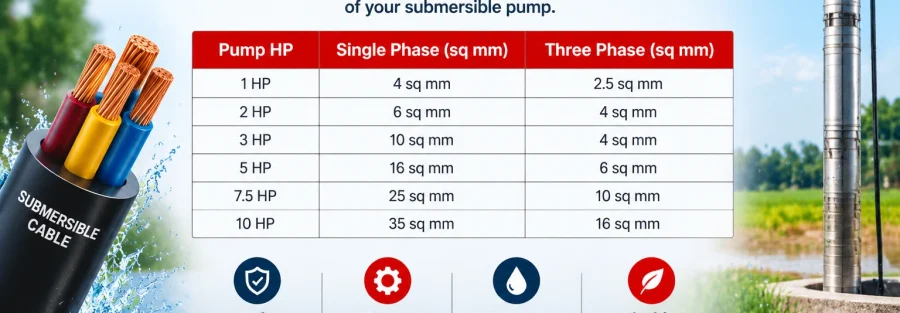
Submersible Cable Size Chart by HP
The table below gives commonly recommended copper conductor sizes for submersible cable, based on typical borewell depths up to roughly 150 feet. For deeper installations, always move up one size to
Pump HP
Single Phase (sq mm)
Three Phase (sq mm)
1 HP
4 sq mm
2.5 sq mm
2 HP
6 sq mm
4 sq mm
3 HP
10 sq mm
4 sq mm
5 HP
16 sq mm
6 sq mm
7.5 HP
25 sq mm
10 sq mm
10 HP
35 sq mm
16 sq mm
This chart is a general guideline for typical depths. Always confirm exact sizing against your pump manufacturer’s specification sheet and local depth conditions before final purchase — depth, expected duty cycle and local voltage stability can all shift the recommended size.
How to Read and Use This Cable Size Chart
Start by confirming your pump’s exact HP rating and whether it runs on single-phase or three-phase power — this is usually printed on the motor nameplate. Match that to the table above for a baseline cable size. Then check your borewell depth: if it exceeds roughly 150 feet, or if you expect the pump to run for many continuous hours per day (as with agricultural irrigation during peak season), move up to the next cable size to keep voltage drop within safe limits.
What Happens If You Use an Undersized Cable
An undersized submersible cable doesn’t fail immediately — which is exactly what makes it dangerous. Instead, it causes a slow, cumulative problem: excess voltage drop forces the motor to draw more current to compensate, which generates extra heat in both the cable and the motor windings. Over months of operation, this heat degrades the winding insulation, eventually leading to a motor burnout — a far more expensive repair than the cost difference between the correct cable size and an undersized one.
Copper Conductor Quality Matters as Much as Size
Cable size on paper only delivers its rated performance if the copper conductor inside is high-purity, properly annealed copper with the stated cross-sectional area — not a thinner conductor padded out with extra insulation to look like the right gauge. This is a common corner cut by unbranded cable suppliers, and it’s one of the reasons an ISI-marked, IS 694-compliant cable from a known manufacturer is worth the price difference over an unbranded alternative.
Buying the Right Submersible Cable Size
Janta Cables manufactures both PVC Insulated Submersible Cable and XLPE Insulated Submersible Cable under the Rajat brand in a full range of conductor sizes, so you can match the exact size your pump and borewell depth require — backed by a 10-year guarantee. If you’re unsure which size fits your installation, our team can help you size it correctly based on your pump’s HP and your borewell depth before you order.
Frequently Asked Questions
Can I use a smaller cable size to save cost if my borewell isn't very deep?
−
Only within limits. Even at shallow depths, cable size still needs to match the pump's HP and current draw — going below the recommended size at any depth risks overheating.
Does cable size differ for single-phase and three-phase pumps of the same HP?
+
Yes. Three-phase motors typically require a smaller conductor size than single-phase motors of the same HP, since current is split across three conductors instead of two.
What is an acceptable voltage drop for submersible cable runs?
+
Most guidelines recommend staying under 3–5% voltage drop at the pump end. If your depth or duty cycle pushes beyond this, move up one cable size.
Getting your submersible cable size right the first time protects your pump motor, avoids repeat cable-pulling jobs, and keeps your total cost of ownership lower over the life of the installation.